
Can You Trust the Product—and the Company Behind It?
Learn what trustworthy cosmetic companies make visible—and which warning signs deserve a closer look.
A practical guide to adulterated and misbranded cosmetics, unlawful drug claims, organic representations, product labeling, manufacturing transparency, and reporting concerns.
| Important legal context This article provides general consumer education, not a legal determination about any particular product or company. Only the appropriate regulatory agency or court can determine that a specific product is adulterated, misbranded, an unapproved drug, deceptively advertised, or falsely represented as organic. Consumers should document observable facts and avoid treating unanswered questions as proof of wrongdoing. |
|---|
1. What “Adulterated” and “Misbranded” Mean
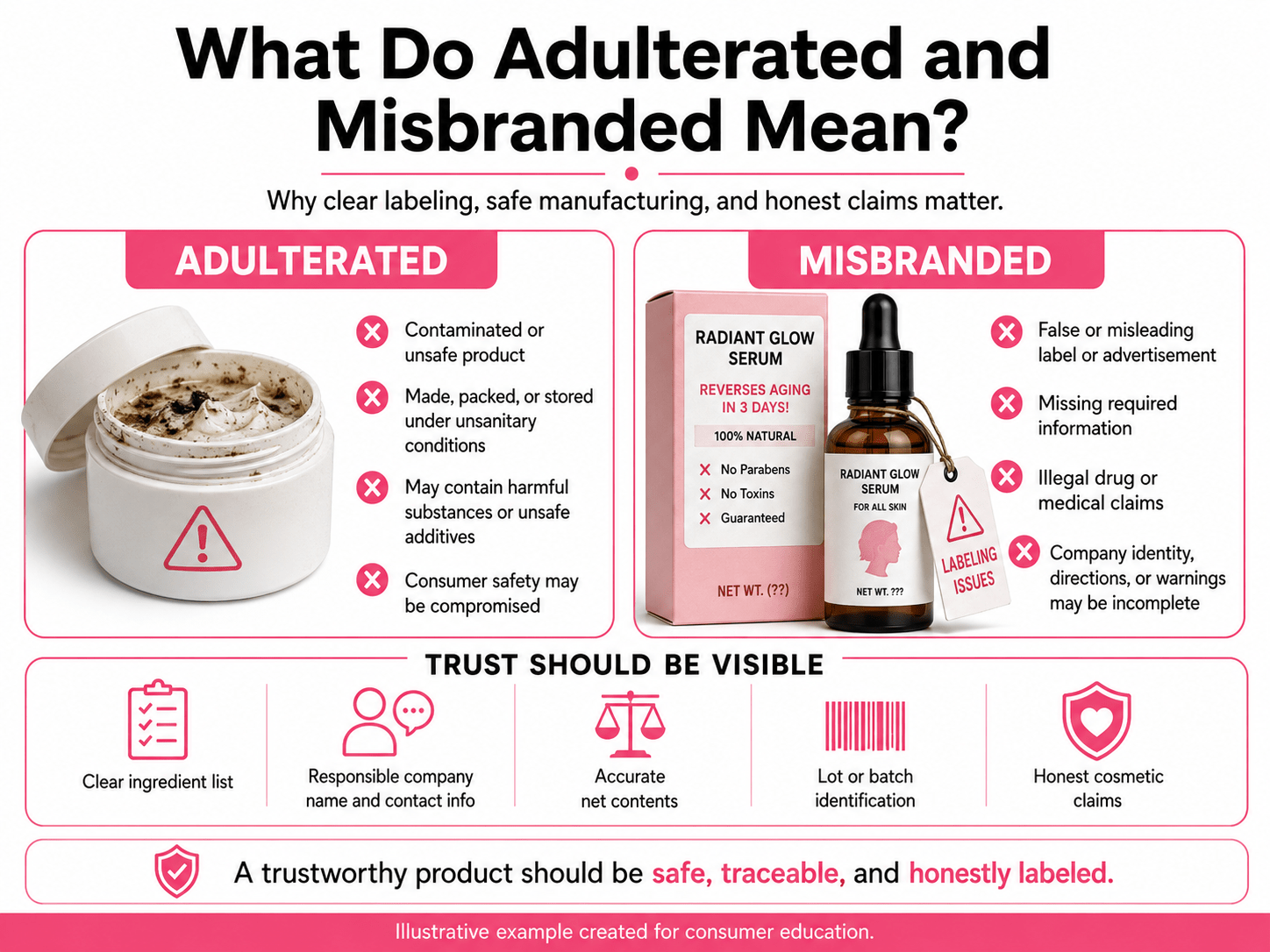
Trust should be visible
Consumers should be able to identify the product, read its directions and ingredients, locate the responsible company, and find traceability information without having to investigate basic facts.
The FDA regulates cosmetics sold in interstate commerce under the Federal Food, Drug, and Cosmetic Act, as expanded by the Modernization of Cosmetics Regulation Act of 2022 (MoCRA). Cosmetics do not generally require FDA premarket approval, except for applicable color additives, but companies remain legally responsible for product safety and proper labeling.
Adulterated cosmetics
“Adulterated” generally concerns the product’s composition, safety, manufacturing, packaging, or contamination. A cosmetic may be adulterated when, for example, it contains a poisonous or harmful substance, contains an unsafe or improperly used color additive, has been prepared or stored under unsanitary conditions, or is held in a container that may make the contents harmful.
- Microbial contamination from water, ingredients, equipment, containers, hands, or the environment
- Foreign material, mold, unexpected separation, gas, swelling, discoloration, or unusual odor
- Unsafe ingredient concentrations or incompatible ingredient combinations
- Poorly controlled heating, cooling, filling, storage, or transport
- Packaging that reacts with, leaks into, or fails to protect the formula
Misbranded cosmetics
“Misbranded” generally concerns false, misleading, incomplete, improperly displayed, or deceptive labeling and packaging. A cosmetic may be misbranded when required information is missing, the label is misleading, or the container is filled or presented deceptively.
- An incomplete or inaccurate ingredient declaration
- An incorrect net-quantity statement
- A false or misleading product identity or purpose
- Missing manufacturer, packer, or distributor information
- Required warnings or directions omitted or obscured
- Claims that imply FDA approval or government endorsement when none exists
- A website description that materially conflicts with the physical label
| A small or home-based business is not automatically unlawful FDA allows cosmetics to be made by small and home-based businesses. The business still must ensure that its products are safe under labeled or customary conditions of use, are not adulterated or misbranded, and comply with applicable federal, state, and local requirements. The concern is not the size of the business—it is whether the company can demonstrate competent manufacturing, labeling, documentation, and accountability. |
|---|
2. Cosmetics Versus Drugs: Why Claims Matter
A cosmetic is generally intended to cleanse, beautify, promote attractiveness, or alter appearance. A product is a drug when its intended use is to diagnose, cure, mitigate, treat, or prevent disease, or to affect the structure or function of the body. A product can also be both a cosmetic and a drug.
FDA evaluates intended use from the complete presentation—not merely the ingredient list or the category selected by the seller. Evidence may include the product name, label, website, directions, testimonials, scientific citations, social-media posts, videos, and the conditions for which consumers are told to use it.
Generally cosmetic-oriented wording
- Moisturizes and conditions dry skin
- Softens rough skin and cuticles
- Improves the appearance of brittle or discolored-looking nails
- Helps skin or nails feel smoother and more flexible
- Helps reduce the visible appearance of dryness, peeling, or roughness
- Cleanses, perfumes, beautifies, or temporarily coats the nail or skin
Claims that may establish a drug purpose
- Treats, cures, mitigates, or prevents fungal or bacterial infection
- Kills fungus, stops fungal growth, or fights named microorganisms
- Treats onychomycosis, athlete’s foot, eczema, inflammation, or another diagnosed condition
- Heals tattoos, cuts, burns, broken skin, or wounds
- Repairs living tissue or speeds healing
- Relieves pain, swelling, inflammation, or infection
- Changes nail growth, nail formation, circulation, or another body function
- Protects injured skin as a therapeutic skin protectant
- Prevents disease recurrence or provides a treatment regimen until “complete healing”
Words such as “healing,” “repair,” “recovery,” “rescue,” “antifungal,” and “skin protectant” are not automatically unlawful in every context. Their meaning depends on the surrounding claims. When paired with disease, injury, inflammation, infection, or tissue repair, they can contribute to a therapeutic intended use.
3. What Consumers Should Find on a Cosmetic Label
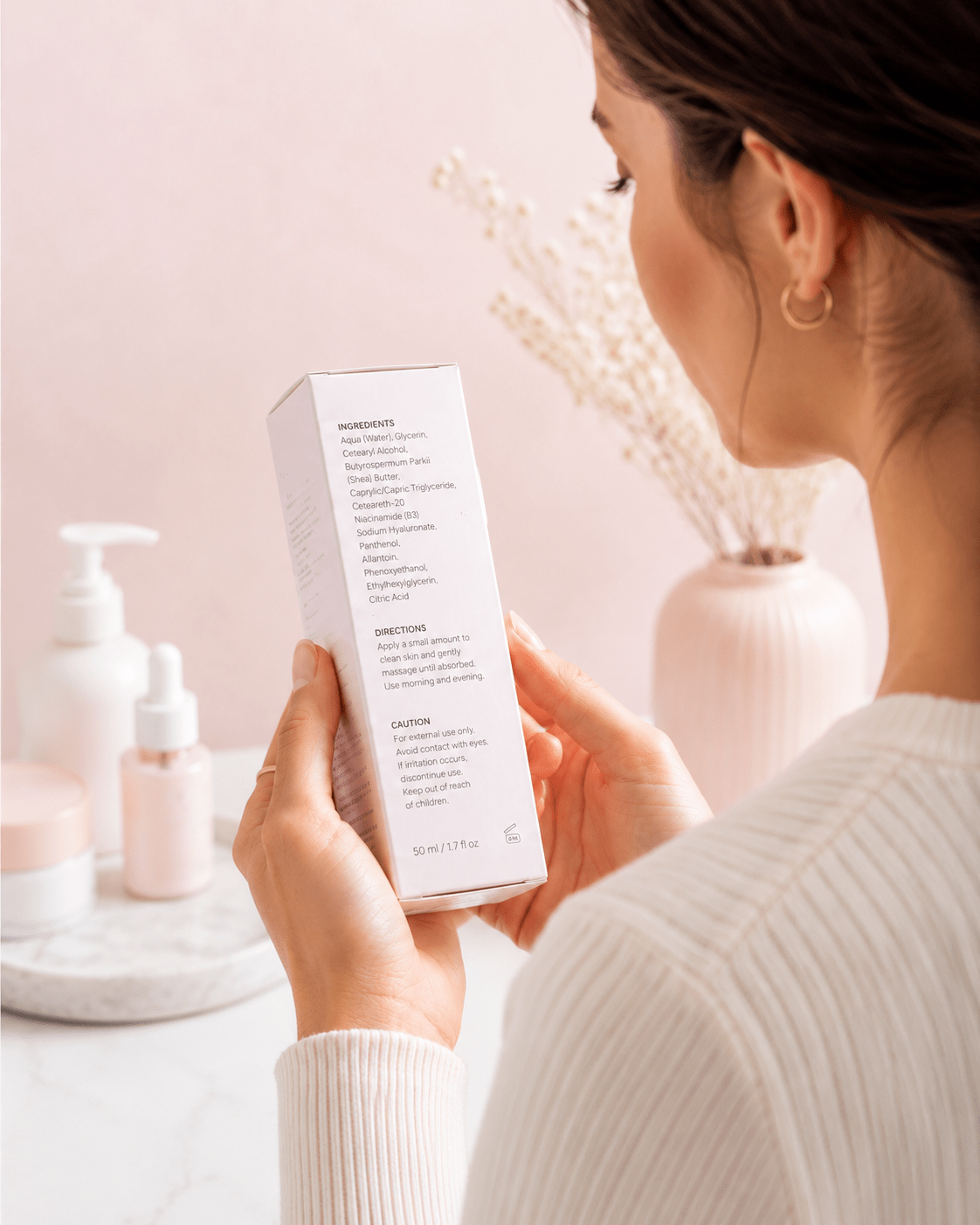
For an ordinary retail cosmetic, consumers should generally be able to identify what the product is, how much it contains, what is in it, and who is responsible for marketing it. Exact requirements depend on the product and packaging configuration, but the following are core trust and compliance signals:
- A clear statement of identity, such as nail oil, foot cream, cuticle conditioner, or moisturizer
- An accurate net quantity of contents in the required units
- The name and place of business of the manufacturer, packer, or distributor
- A complete ingredient declaration using appropriate ingredient names
- Warnings or caution statements needed for safe use
- Directions when the product is not self-explanatory
- A domestic address, telephone number, or electronic contact through which adverse events can be reported, as applicable under MoCRA
Helpful traceability signals
Not every item below is mandatory for every cosmetic, but their presence can help a responsible company investigate complaints and conduct a recall:
- Lot or batch number
- Manufacturing or fill date
- Tamper-evident packaging where appropriate
- Storage instructions
- A reachable customer-service contact
- Consistent product names and quantities across the package, website, receipt, and invoice
- A clear statement such as “Manufactured for” or “Distributed by” when the named company did not manufacture the product
Consumers should verify units carefully. Milliliters, fluid ounces, and net-weight ounces are not interchangeable. Repeated mistakes involving decimal placement, size descriptions, or conflicting quantities may reveal weak label-review procedures even when a single error is merely typographical.
4. Manufacturing, Contamination, and Repackaging Risks
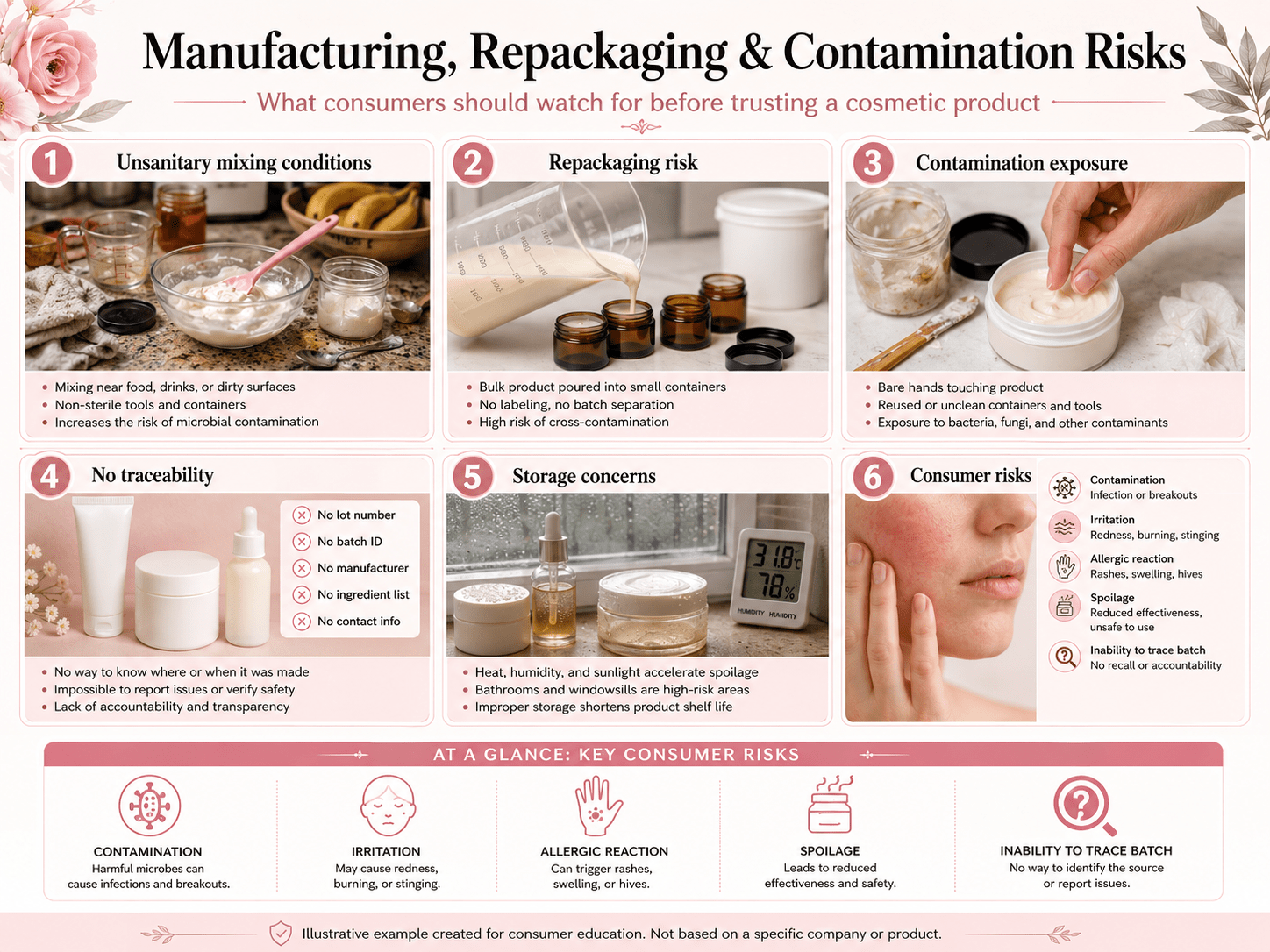
Safe manufacturing requires systems
Professional packaging is only one part of product safety. Responsible manufacturers also control ingredients, sanitation, filling, storage, batch records, complaints, and recalls.
A formula can become contaminated or unstable through raw materials, water, equipment, air, packaging, storage, shipping, or consumer use. Products containing water generally require particular attention to microbiological control and preservation. An attractive ingredient list does not prove that the finished product was made safely.
High-risk practices and warning signs
- Mixing or filling near food preparation, pets, laundry, salon debris, open trash, or uncontrolled dust
- Using tap water or botanical infusions without understanding microbial risk
- Reusing containers without a validated cleaning and sanitizing process
- Scooping, mixing, or filling with bare hands
- “Topping off” partially used containers
- Diluting a commercial product or adding ingredients without reformulation and safety review
- Using packaging not evaluated for compatibility with the formula
- No batch records, ingredient lot records, sanitation procedures, or complaint log
- No method for isolating a questionable batch or identifying which customers received it
- Continuing to sell a batch after reports of odor, separation, mold, irritation, leaking, or other abnormalities
Reselling, private labeling, and repackaging are different activities
Consumers and salon buyers should distinguish among reselling an intact manufacturer-sealed product, legitimate private labeling through a qualified manufacturer, dividing a bulk product into smaller containers, altering an existing product, and manufacturing a formula from raw materials. Once a business fills, dilutes, alters, or manufactures a product, it may assume responsibilities far beyond ordinary retailing.
Questions a responsible manufacturer should be able to answer
- Who formulated and manufactures the finished product?
- Is it made in-house, by a contract manufacturer, or purchased as a private-label formula?
- How are ingredient lots and finished batches recorded?
- What sanitation and equipment-cleaning procedures are followed?
- Has the finished formula been evaluated for stability, packaging compatibility, and microbial risk as appropriate?
- How are preservative effectiveness and water activity considered for water-containing products?
- How are complaints, adverse events, and recalls handled?
5. Scientific Claims, Testimonials, and Disclaimers
A disclaimer does not erase the advertisement
A statement such as “not intended to diagnose, treat, cure, or prevent disease” does not neutralize a sales page that repeatedly promises to treat infection, soothe eczema, stop fungal growth, repair broken skin, or produce complete healing. Regulators evaluate the overall message conveyed to a reasonable consumer.
Testimonials count as advertising claims
A company cannot safely use a customer testimonial to communicate a claim it could not substantiate or lawfully make directly. Featuring statements about cuts, burns, infections, eczema, pain, or fungal disease on a product page can become part of the company’s advertising message.
Personal stories can establish intended use
A founder’s statement that a product was created for a child’s eczema, an injured tattoo, or another condition can function as a product claim when used on a sales page. Calling it a personal story does not remove the commercial message.
Ingredient studies do not automatically prove the finished product works
Scientific citations can create credibility, but studies involving an individual essential oil, plant extract, laboratory organism, or different formulation do not automatically establish the safety or effectiveness of the finished retail product. Consumers should ask:
- Was the actual finished formula studied?
- Were the same ingredient concentrations and application methods used?
- Was the research conducted on humans or only in a laboratory?
- Did the study evaluate the same disease or outcome promised in the advertisement?
- Were adverse effects, stability, and product delivery evaluated?
- Does the evidence support the exact claim—not merely a related ingredient theory?
The FTC expects objective health and safety claims to be truthful, nonmisleading, and supported by competent and reliable scientific evidence appropriate to the claim. The company should possess adequate substantiation before advertising the benefit.
6. Organic and Natural Claims
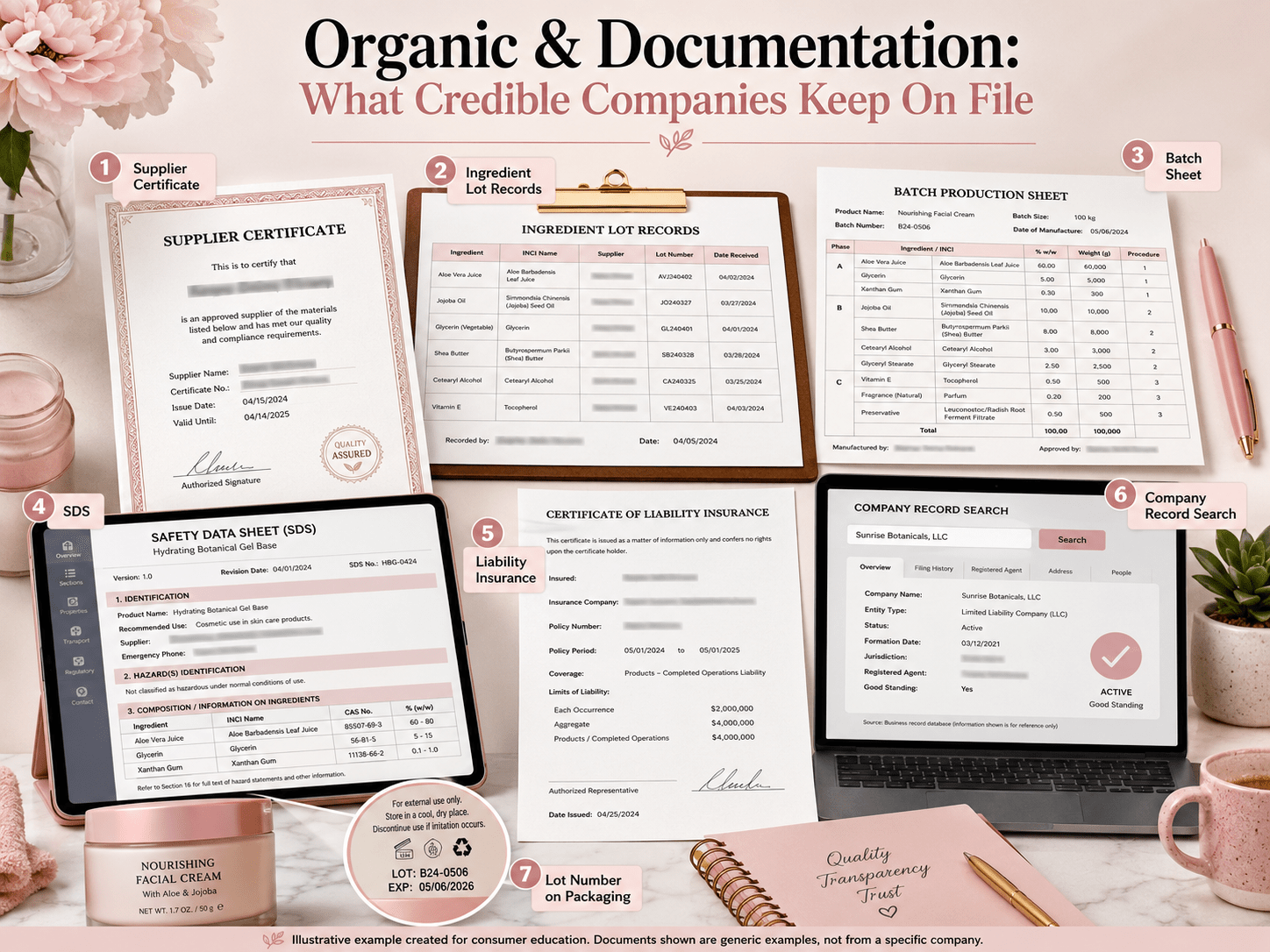
Organic claims should have a paper trail
Credible claims can be connected to supplier certificates, invoices, ingredient lots, production batches, and the company responsible for the finished product.
FDA does not define “organic” for cosmetics. USDA’s National Organic Program governs qualifying organic agricultural claims, while FDA continues to regulate cosmetic safety and labeling. FTC standards also require organic and natural advertising claims to be truthful and nonmisleading.
USDA organic labeling categories
| Category | General organic-content threshold | Key labeling point |
|---|---|---|
| 100 percent organic | All qualifying ingredients must be certified organic, apart from permitted processing aids | May use the USDA Organic seal when requirements are met. |
| Organic | At least 95 percent certified organic content, excluding water and salt under the rules | May use the USDA Organic seal; certifying-agent identification is required. |
| Made with organic ... | At least 70 percent certified organic content | May identify up to three ingredients or ingredient categories; may not use the USDA Organic seal. |
| Less than 70 percent organic content | Below 70 percent | May identify certified organic ingredients in the ingredient statement but generally may not represent the complete product as organic. |
Proof a company should maintain
- Current organic certificates for applicable suppliers or operations
- The name of the USDA-accredited certifying agent when certification applies
- Supplier invoices tying purchases to certified sources
- Ingredient lot numbers and receiving records
- Formulas showing applicable organic percentages
- Batch records connecting specific ingredient lots to finished products
- Documentation supporting any claimed exemption
- Label approval by the certifying agent when required
A certificate for one ingredient supplier does not prove that every ingredient—or the finished product—is organic. “Contains an organic ingredient,” “made with organic ingredients,” “organic,” and “100 percent organic” are different representations.
Organic does not mean safer or more effective
Organic ingredients can still cause irritation, sensitization, allergic reactions, oxidation, or contamination. Organic certification does not prove that a product treats disease, is suitable for babies or broken skin, is properly preserved, or was manufactured under sanitary conditions.
Natural, plant based, vegan, and chemical free
These terms are not interchangeable with organic. “Natural” is not formally defined by FDA for cosmetics, but the claim must still be truthful. “Plant based” does not mean organically produced. “Vegan” does not mean natural or organic. “Chemical free” is scientifically misleading because all cosmetic ingredients—including water and plant oils—are chemicals.
7. Safety Data Sheets and Workplace Chemical Safety
A Safety Data Sheet (SDS) is a standardized workplace hazard-communication document, not proof of FDA approval, product effectiveness, microbiological safety, or organic certification. OSHA generally requires an SDS for a chemical classified as hazardous when supplied for occupational use.
Not every finished cosmetic legally requires an SDS. Consumer-product exemptions may apply when workplace use is comparable in duration and frequency to ordinary consumer use. Professional salon products and hazardous manufacturing raw materials may be treated differently.
What a responsible company should understand
- Whether each raw material is hazardous and has an applicable supplier SDS
- Whether the finished product requires a product-specific SDS for workplace distribution
- Safe storage, ventilation, fire, spill, first-aid, and personal-protection requirements
- Whether professional use creates greater exposure than ordinary household use
- How to provide accurate safety information without pretending that an SDS is an FDA endorsement
SDS red flags
- The seller refuses to provide an applicable SDS for an apparently hazardous professional product
- The document identifies a different product or company without explanation
- The SDS is copied from a raw ingredient and presented as if it covered the finished formula
- The ingredient or hazard information conflicts with the label
- A generic internet template contains no product-specific evaluation
- The seller says a proprietary formula eliminates all hazard-disclosure obligations
- The company claims the SDS proves FDA approval or consumer safety
8. Business Trust Signals, Insurance, and Accountability
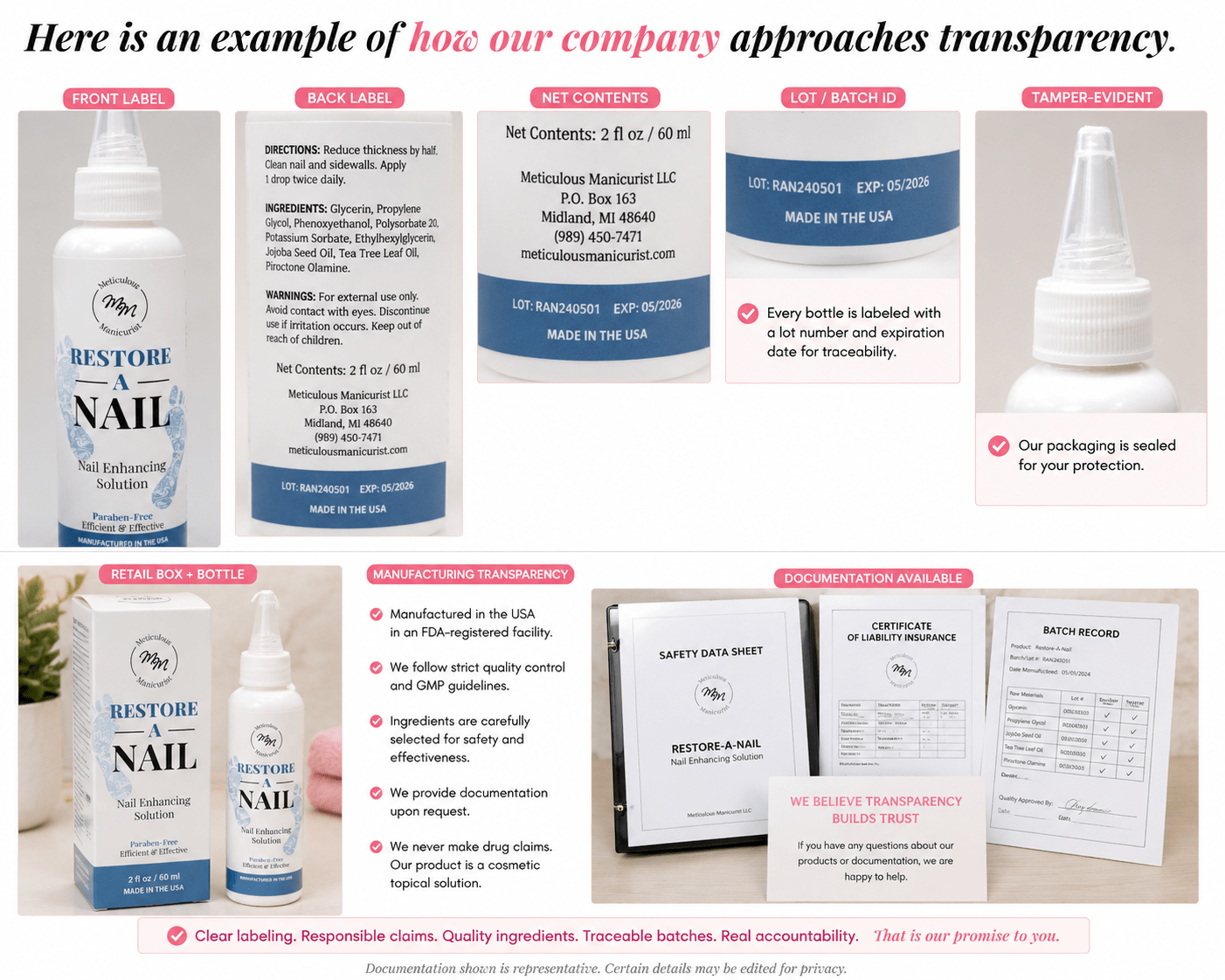
Accountability should connect the product to a real business
Look for consistent company information, accessible contact details, traceable batches, appropriate insurance, and documentation that matches the product and activities being advertised.
Consumers should be able to identify the person or entity responsible for the product. Under MoCRA, the “responsible person” is generally the manufacturer, packer, or distributor whose name appears on the label. Depending on applicable exemptions and requirements, that party may have duties involving product listing, safety substantiation, records, adverse-event reporting, and contact information.
Positive company trust signals
- A consistent legal or registered business name
- Current public business registration when required
- A real business or mailing address and working contact information
- Clear disclosure of whether the business manufactures, packs, distributes, or private-labels the product
- Consistent company information across labels, websites, invoices, payment receipts, and shipping materials
- Written return, complaint, privacy, and adverse-event procedures
- Professional responses to reasonable ingredient, safety, and documentation questions
- Traceable lots and a recall or corrective-action procedure
What an inactive or inconsistent business record does—and does not—prove
An inactive, dissolved, or outdated LLC record does not prove that a product is unsafe, the company lacks insurance, or a violation occurred. Some businesses operate as sole proprietors, and registration rules vary. It is nevertheless a legitimate warning signal when a seller continues to advertise under an inactive entity, uses conflicting names or addresses, or cannot identify which business is legally responsible.
A careful consumer should independently verify business registration, professional licenses, product-manufacturing authority where applicable, and insurance rather than assuming that one current record proves the others exist.
Insurance questions
A salon professional-liability policy, homeowners policy, or ordinary general-liability policy may not cover manufacturing, filling, altering, repackaging, private labeling, home-based production, undisclosed product lines, or drug-treatment claims. Coverage depends on the actual policy and disclosed operations.
- Does the insured business name match the company shown on the label and invoice?
- Is the policy current?
- Does it include product-liability or products-completed-operations coverage?
- Were manufacturing, private labeling, home production, and distribution disclosed?
- Are the actual products, locations, and sales channels covered?
A certificate of insurance is only evidence that a policy existed when issued; it does not guarantee coverage for every product, claim, location, or incident.
9. The Cumulative Red Flags Consumers Should Recognize
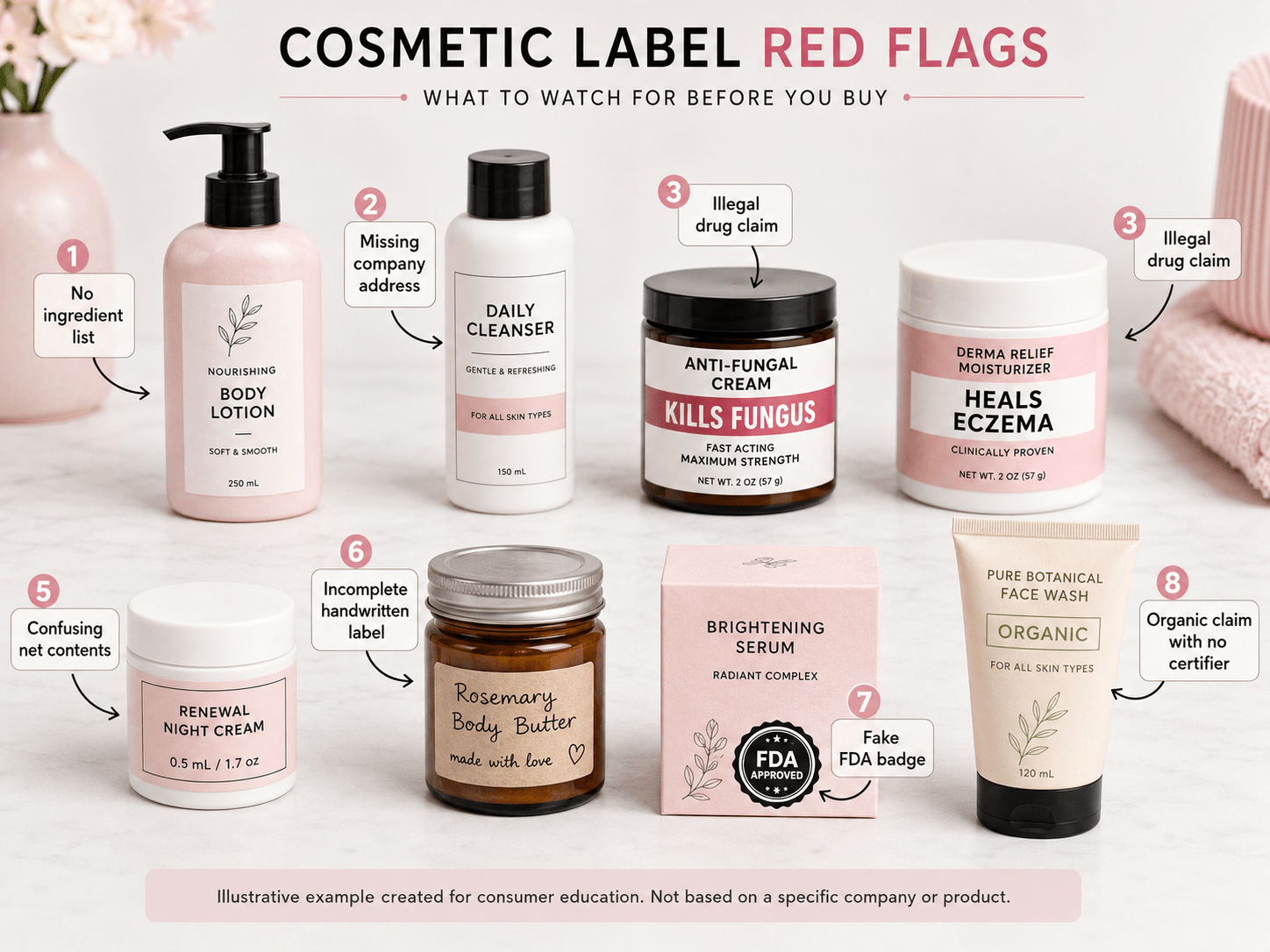
Look for a pattern—not just one typo
Repeated disease claims, missing information, fake approval language, unsupported organic claims, and conflicting measurements can signal a wider problem with regulatory knowledge and accountability.
One awkward phrase or typographical error may have an innocent explanation. A repeated pattern across a product line is more significant. Consumers should pause when several of the following appear together:
- Repeated antifungal, antimicrobial, eczema, inflammation, wound, healing, or tissue-repair claims on products marketed as cosmetics
- A disclaimer denying disease treatment while the sales copy promises treatment, healing, or prevention
- Product names and directions that reinforce a therapeutic treatment regimen
- Testimonials involving cuts, burns, infections, eczema, pain, broken skin, or other medical conditions
- Claims that a topical product changes nail growth, nail structure, circulation, or another body function
- Scientific citations that concern individual ingredients rather than the finished product
- Claims of deep penetration, biological balance, noncomedogenicity, infant safety, or universal safety without visible product-specific substantiation
- Repeated organic claims without identification of certification, supplier traceability, or the specific ingredients covered
- “All-natural” used as a substitute for safety data, testing, or preservation controls
- Conflicting quantities, product sizes, ingredient lists, or company identities across labels and websites
- No clear lot identification, complaint process, manufacturing accountability, or recall capability
- Refusal to answer reasonable questions about the manufacturer, formulation, insurance, SDS documentation, or adverse-event process
- An inactive or unidentifiable business entity used on labels or sales pages without explaining who is currently responsible
- Hostile, evasive, or disappearing responses when consumers ask about ingredients, reactions, records, or compliance
| Look at the pattern—not one document An active LLC does not prove proper manufacturing. An insurance certificate does not prove the formula is safe. An SDS does not prove FDA compliance. An organic certificate for one ingredient does not prove the whole product is organic. A complete ingredient list does not prove correct measurements or sanitary production. Trust comes from the way all records and representations fit together. |
|---|
10. How to Evaluate a Company Before Purchasing
Search the company through the official business registry in the state where it claims to operate. Confirm the status, name, address, and registered agent where available.
Compare the business name on the label, website, payment receipt, shipping label, return policy, and any insurance certificate.
Read the complete product page, including directions, testimonials, disclaimers, FAQs, blogs, and social-media claims.
Check whether the product is being sold for appearance and conditioning or for disease, infection, injury, inflammation, pain, or body-function effects.
Look for a complete ingredient declaration, accurate quantity, responsible-party contact, and batch identification.
Ask who manufactures and fills the product and whether it is in-house, contract-manufactured, private-labeled, repackaged, or altered.
Ask what documentation supports any organic, natural, safety, penetration, clinical, antimicrobial, noncomedogenic, or infant-use claim.
For professional or wholesale purchases, request applicable SDS information and evidence of insurance appropriate to the company’s actual activities.
Assess how professionally the company handles questions and complaints. A trustworthy company should document concerns rather than attack or silence the consumer.
Three levels of concern
| One isolated concern | A typo, awkward phrase, or missing webpage detail may be correctable. Ask for clarification and compare the answer with the physical label. |
|---|---|
| Several unanswered questions | Conflicting names, vague claims, missing records, unclear quantities, or unverifiable organic representations justify delaying the purchase. |
| A repeated pattern of serious claims | Repeated disease claims, healing promises, contradictory disclaimers, injury-related testimonials, missing accountability, and refusal to provide documentation are substantial warning signs. A consumer does not need to prove a federal violation before deciding not to buy. |
11. How to Preserve Evidence and Report a Concern
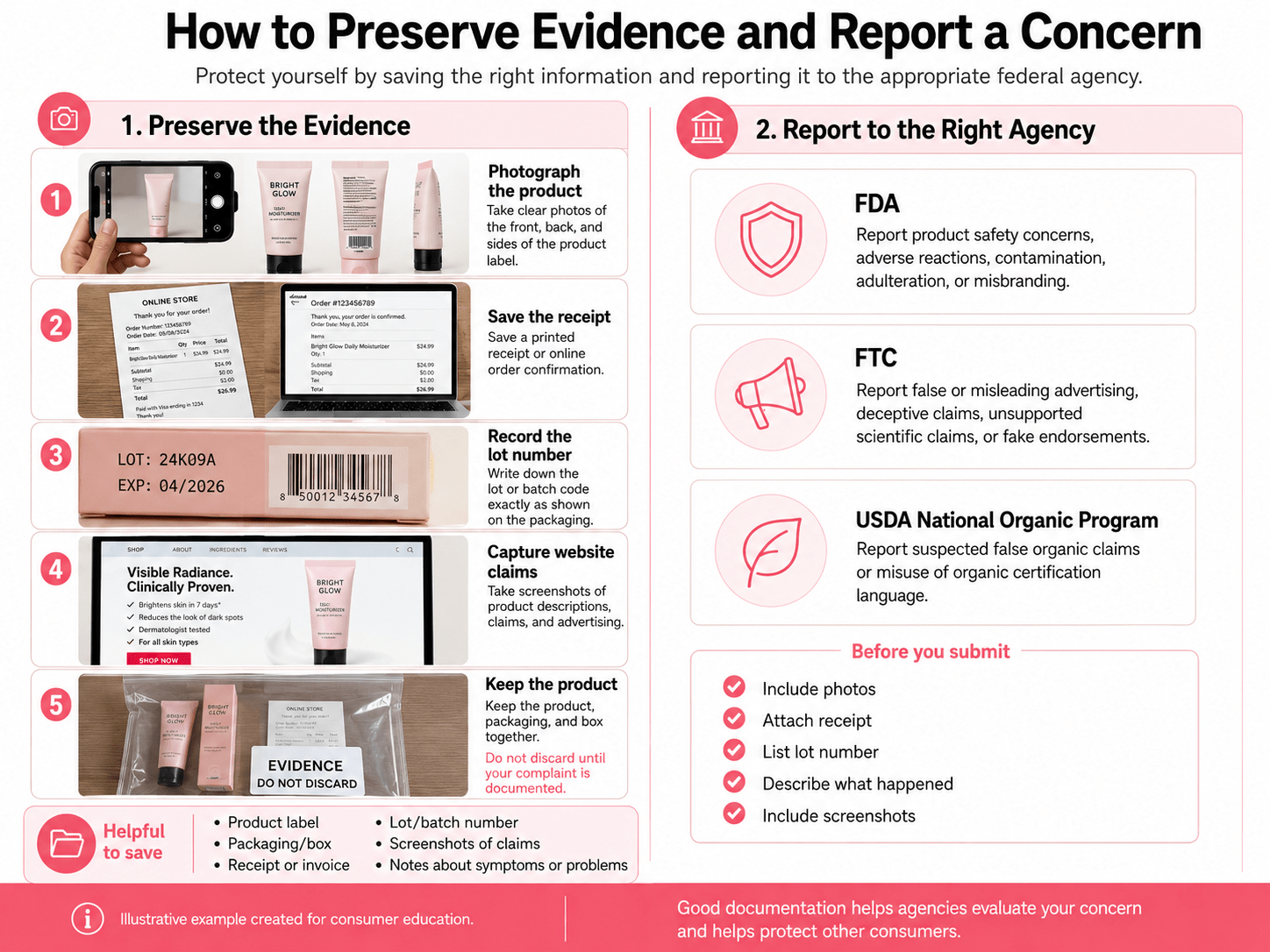
Good reports are factual and complete
Clear photographs, receipts, batch information, screenshots, and a concise description help the appropriate agency evaluate the concern.
Preserve evidence before returning or discarding the product
- Stop using the product if it has changed odor, color, texture, pressure, or appearance, or if it causes a reaction.
- Keep the product, box, receipt, shipping materials, and order confirmation.
- Photograph every side of the container and label, including the quantity and lot number.
- Save screenshots or PDFs of product pages, testimonials, videos, organic claims, and disease-treatment statements.
- Record the date purchased, date opened, manner of use, symptoms, and medical care.
- Do not repeatedly open or handle a product that appears contaminated.
- Do not send the only remaining sample back before documenting it and confirming how evidence will be preserved.
Report cosmetic safety and quality concerns to FDA
Consumers may report adverse reactions, contamination, unusual product changes, defective packaging, and other cosmetic safety or quality problems to FDA. Include the product name, manufacturer or distributor, purchase information, lot number, photographs, symptoms, medical care, and remaining product details when available.
Report deceptive advertising to FTC
FTC accepts reports involving deceptive or unsupported advertising, including health, safety, scientific, testimonial, endorsement, and online sales claims. The complaint should quote the exact representation and explain what evidence made it appear misleading.
Report suspected false organic claims to USDA
USDA’s National Organic Program accepts complaints concerning misuse of organic claims, fraudulent certificates, misuse of the USDA Organic seal, or products represented as organic without apparent support. Provide labels, screenshots, receipts, certificates, and the specific reasons the representation appears inconsistent.
Other possible reporting channels
- The state attorney general or consumer-protection office
- The applicable state cosmetology or professional-licensing board when the seller is a licensee and the conduct relates to licensed business activity
- The local business-licensing, health, zoning, or tax authority when appropriate
- The online marketplace, advertising platform, payment processor, or retailer
- A physician or poison-control resource when an immediate medical concern exists
A complaint is strongest when it reports observable facts rather than declaring guilt. For example: “The sales page states that the product treats fungal infection, but the package appears to be labeled only as a cosmetic,” or “The product is advertised as USDA certified organic, but no certifying agent is identified.” The agency can determine whether a violation occurred.
12. Potential Consequences for Companies
FDA, FTC, USDA, state agencies, courts, insurers, retailers, and payment platforms have different authority. The consequences depend on the facts, consumer risk, evidence, intent, duration, sales volume, prior warnings, and whether the company promptly corrects the problem.
Possible FDA consequences
- Public warning letters
- Requests for corrective action and records
- Voluntary or mandatory recalls under the statutory conditions
- Product seizure
- Federal injunctions or restraining orders
- Suspension of cosmetic facility registration under qualifying MoCRA conditions
- Import detention, refusal, or import alert
- Civil or criminal enforcement through the Department of Justice in serious cases
- Individual responsibility for owners or officials under applicable law
Possible FTC consequences
- Investigations and compulsory demands for advertisements, testing, complaints, sales records, and scientific support
- Orders prohibiting deceptive claims and requiring substantiation for future claims
- Long-term recordkeeping, monitoring, and compliance reporting
- Civil penalties where authorized by statute, rule, prior order, or qualifying notice
- Consumer refunds or other monetary relief where legally available
- Restrictions on owners, officers, marketers, endorsers, or future business activity
- Liability for claims communicated through testimonials, influencers, or implied advertising messages
Possible USDA National Organic Program consequences
- Notice of noncompliance and required corrective action
- Suspension or revocation of organic certification
- Loss of the right to use the USDA Organic seal or represent affected products as organic
- Relabeling, withdrawal, or cease-and-desist requirements
- Civil penalties for knowing violations, subject to current statutory and inflation-adjusted limits
- Investigation of false statements, fraudulent certificates, or falsified records
- Settlement agreements, audits, training, monitoring, and public enforcement records
Private and commercial consequences
- Product-liability claims or lawsuits
- Insurance cancellation, nonrenewal, reservation of rights, or denial of coverage for undisclosed activities
- Marketplace or payment-account suspension
- Advertising-account termination
- Chargebacks, refunds, and loss of wholesale accounts
- Contract termination and distributor disputes
- Damage to search results, professional reputation, and consumer trust
- The cost of recalls, legal advice, product destruction, relabeling, and corrective testing
Correcting a website after a complaint does not necessarily erase prior labels, archived webpages, screenshots, videos, customer emails, previous sales, injuries, or record-preservation duties. Small-business status and lack of knowledge do not generally authorize unsafe products, false statements, deceptive advertising, or unlawful disease claims.
13. Consumer Decision Checklist
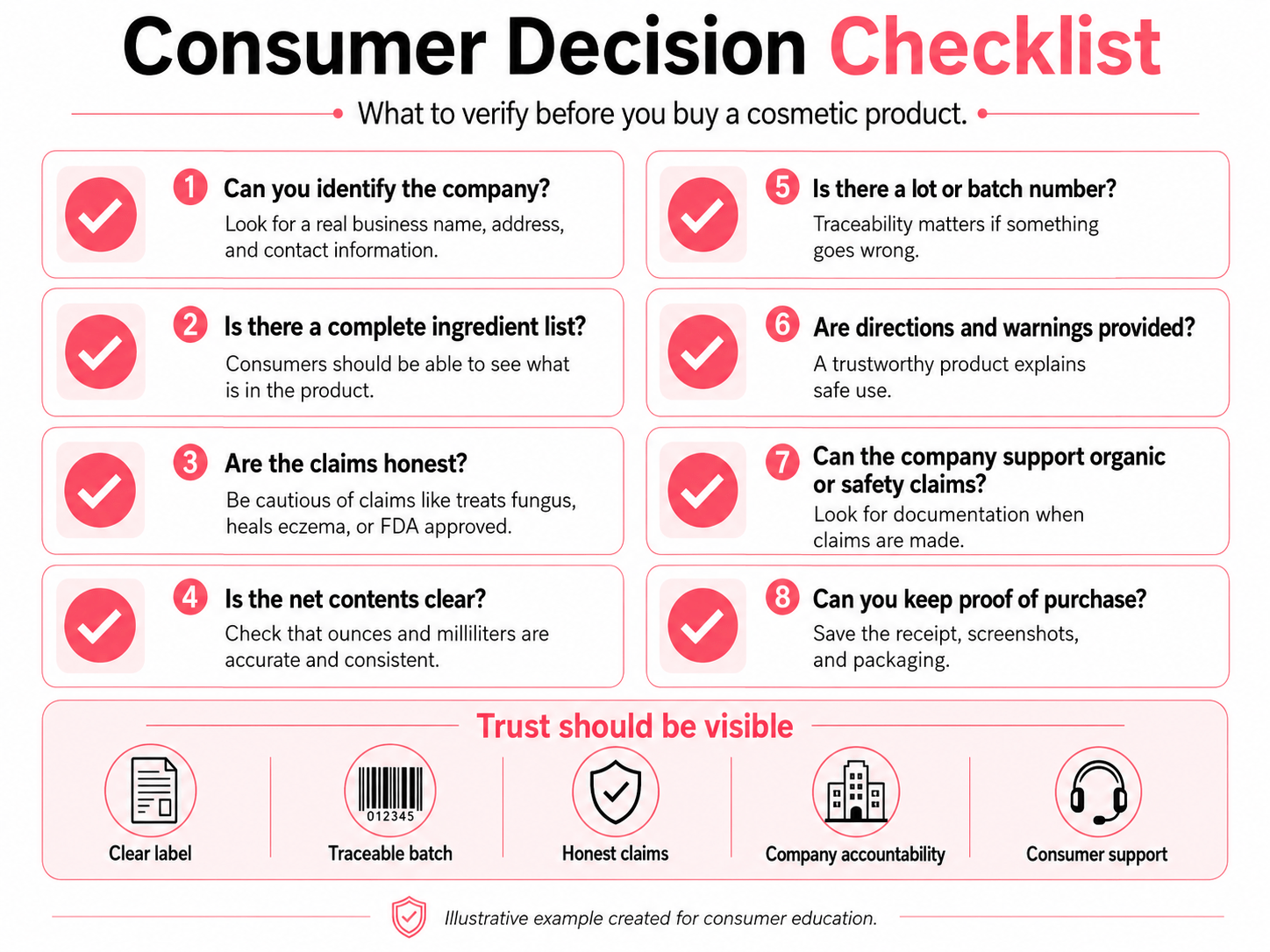
Pause before you purchase
A trustworthy company should make it easy to understand what the product is, who is responsible for it, what it contains, how to use it safely, and what the company is—and is not—claiming it can do.
| Check | Consumer question |
|---|---|
| Identity | Can you identify the legal business and the responsible manufacturer, packer, or distributor? |
| Label | Does the product have a clear identity, accurate quantity, complete ingredients, and reliable contact information? |
| Claims | Are the promises limited to cosmetic appearance and conditioning, or do they treat disease, infection, injury, inflammation, pain, or body function? |
| Evidence | Does the company have finished-product support for scientific, clinical, safety, penetration, noncomedogenic, infant-use, or antimicrobial claims? |
| Organic | Can the business document which ingredients or products are certified organic and identify the certifying agent when required? |
| Manufacturing | Can the company explain who makes the product, how batches are traced, and how contamination is controlled? |
| SDS | Does the company understand and provide applicable workplace hazard information for professional products and hazardous raw materials? |
| Insurance | Does its insurance appear to match the legal entity, location, product activities, and claims? |
| Accountability | Does the company document complaints, investigate affected batches, report serious adverse events when required, and communicate professionally? |
| Consistency | Do the label, website, receipt, business records, certification, safety documents, and marketing tell the same story? |
| Final principle A consumer does not need to prove that a company violated federal law before deciding that it has not earned their trust. When public claims are repeatedly inaccurate, therapeutic, contradictory, unsupported, or difficult to verify, it is reasonable to question how carefully the company manages the less visible responsibilities of formulation, sanitation, testing, recordkeeping, insurance, and complaint handling. |
|---|
Official Sources and Reporting Resources
- FDA: Modernization of Cosmetics Regulation Act of 2022 (MoCRA)
- FDA: Small Businesses and Homemade Cosmetics Fact Sheet
- FDA: Cosmetics Labeling Claims
- FDA: Is It a Cosmetic, a Drug, or Both?
- FDA: Summary of Cosmetics Labeling Requirements
- FDA: Registration and Listing of Cosmetic Product Facilities and Products
- FDA: How to Report a Cosmetic Product Related Complaint
- FDA: Recall Policy for Cosmetics
- FDA: Organic Cosmetics
- FTC: Health Products Compliance Guidance
- FTC: Report Fraud
- USDA AMS: Cosmetics, Body Care, and Personal Care Products
- USDA AMS: Labeling Organic Products
- USDA AMS: Organic Integrity Database
- USDA AMS: File an Organic Complaint
- OSHA: Hazard Communication Standard and Safety Data Sheets
Publication note: Federal requirements and agency procedures can change. Verify current rules and reporting instructions through the official agency resources above before publication or filing a complaint.
See a concerning product claim?
Preserve the label, receipt, screenshots, lot number, and product before filing a factual report with the appropriate agency.