
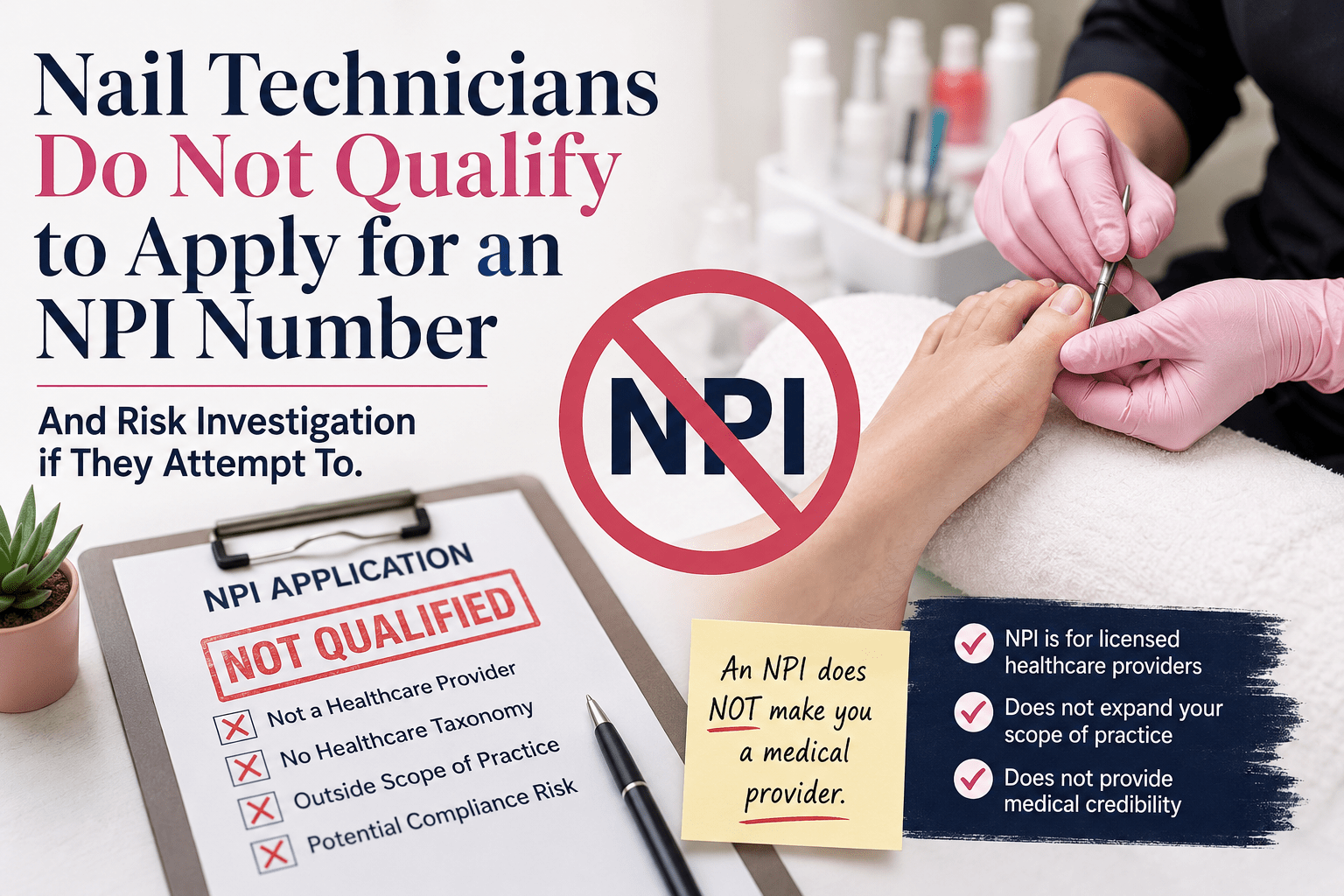
Can Nail Technicians Get an NPI Number?
A nail technician acting only under a cosmetology or nail-technology license does not become a healthcare provider by completing an advanced pedicure course, working with a podiatrist, serving clients with diabetes, or calling a service a “medical pedicure.”
A National Provider Identifier is part of the federal healthcare transaction system. It is not a general business number, certification badge, medical credential, permission to bill insurance, or a way to expand a state-regulated cosmetic scope of practice.
Someone who separately holds a qualifying healthcare credential may legitimately obtain and use an NPI in that separately licensed healthcare capacity. This article addresses people acting solely under a nail-technician, manicurist, pedicurist, or cosmetology license.
What Is a National Provider Identifier?
The Centers for Medicare & Medicaid Services describes an NPI as a unique 10-digit number used to identify covered healthcare providers in standardized healthcare transactions.
An NPI identifies a healthcare provider. It does not create one.
The number does not contain information about the provider’s state or medical specialty. It functions as an administrative identifier in healthcare transactions.
Not a Business ID
An NPI does not replace an EIN, state business registration, salon license, or resale certificate.
Not a Certification
It does not certify training quality, medical competence, or completion of an advanced pedicure course.
Not a Medical License
It does not authorize diagnosis, treatment, prescribing, podiatry, or any other medical service.
Be Proud of the License You Actually Hold.
Nail technicians are licensed by state cosmetology or occupational-licensing authorities to provide services defined by state law. Depending on the state, those services may include grooming, cleaning, shaping, reducing nail length or thickness, applying cosmetic products, providing pedicures, and improving the cosmetic appearance and comfort of the feet and nails.
Those are meaningful, skilled services. They do not need to be renamed as healthcare to be valuable.
A nail license generally does not authorize:
- Diagnosing disease or infection
- Treating a medical condition
- Prescribing a treatment plan
- Performing podiatric procedures
- Billing insurance as a healthcare practitioner
- Using a private certificate to expand legal scope
- Representing a cosmetic pedicure as medical treatment
There Is No Nail-Technician Healthcare Taxonomy.
NPI applicants select a Healthcare Provider Taxonomy Code describing their healthcare classification or specialty. These codes are maintained for healthcare transactions; they are not marketing categories.
An applicant cannot truthfully choose an unrelated healthcare classification merely because it sounds similar to a service the person wants to advertise.
No recognized healthcare taxonomy exists solely for a:
- Nail technician
- Manicurist
- Cosmetologist
- Pedicurist
- “Medical pedicurist”
- Advanced pedicure specialist
What an NPI Does—and Does Not—Prove
“An NPI gives me credibility as a medical-service provider.”
An NPI is an administrative identifier. It does not verify the applicant’s skill, approve advertised services, certify medical competence, or grant permission to use medical terminology.
Your license and state law determine what you may do.
Scope of practice comes from state law and the professional license you actually hold—not from a number, private certification, physician relationship, payment terminal, or service name.
“If the online system issues the number, I must qualify.”
Application information is supplied by the applicant. A number being processed or issued does not independently confirm that every classification or representation was legally supportable.
An issued number cannot expand your scope.
Even a person who legitimately has an NPI must remain within the scope of the healthcare license connected to the services being furnished.
Private Titles and Professional Relationships Do Not Rewrite the Law.
A Private Certificate
Continuing education can strengthen cosmetic service skills but cannot create a healthcare license or federally recognized healthcare profession.
A Podiatrist Relationship
A referral relationship or work location does not transfer a physician’s scope, NPI, billing authority, or medical status to a nail technician.
A Medical-Sounding Title
Calling a service a “medical pedicure” or “diabetic nail trimming” does not transform cosmetic nail care into authorized healthcare.
Changing the Wording on a Receipt Does Not Make an Expense Medical.
Eligibility depends on federal tax rules, plan terms, the actual nature of the expense, and any required substantiation—not simply the terminology used by the seller.
More accurate cosmetic descriptions
Descriptions that can imply unsupported healthcare
A card transaction going through does not prove that the expense qualifies. Clients should verify eligibility with their own HSA or FSA administrator and retain any required substantiation.
An NPI Record Is Publicly Searchable.
A public record can connect a person’s name, business address, and claimed healthcare classification to the federal provider system. Conflicts between that classification, the person’s actual license, and their advertising may raise questions.
What provider classification was selected, and does the applicant hold the credential associated with it?
Is the person advertising diagnosis, treatment, diabetic healthcare, or another service outside cosmetic scope?
Are receipts or payment claims making cosmetic services appear medically reimbursable?
Could the public reasonably believe the technician is medically licensed or authorized to provide healthcare?
It would be inaccurate to claim that every nail technician who applies will automatically be investigated. The concern is that an unsupported classification or conflicting medical advertising can create evidence that attracts regulatory or billing scrutiny.
Build Authority Without Pretending to Be a Medical Provider.
Use Accurate Terms
Describe the cosmetic service actually provided without implying diagnosis, treatment, or medical authority.
Know Your State Scope
Review official statutes, rules, prohibited practices, establishment requirements, and board guidance.
Refer Appropriately
Refer suspected disease, wounds, acute infection, severe pain, and concerns beyond cosmetic care.
Let Clients Verify Benefits
Do not promise HSA or FSA eligibility. Direct clients to their own plan administrator.
Become More Skilled Without Misrepresenting Your License.
STAR NT education is designed to strengthen practical cosmetic pedicure skills, consultation, infection control, toenail reduction, client communication, referral judgment, business systems, and professional confidence.
It does not create a healthcare license, authorize medical diagnosis or treatment, or qualify a nail technician for unsupported healthcare classifications.
- Advanced cosmetic toenail and pedicure techniques
- Clear scope-of-practice boundaries
- Consultation and referral judgment
- Disinfection and professional safety
- Accurate marketing and service terminology
- Private supportive Facebook community for eligible graduates
Official Federal Resources
Regulatory education should direct professionals to original government and standards sources—not ask them to rely on marketing claims.
NPI Numbers, Nail Licenses, and HSA/FSA Claims
Can a nail technician acting only under a nail license get an NPI?
An NPI is for qualifying healthcare providers and requires a healthcare-provider classification. A person acting solely under a nail-technician, manicurist, pedicurist, or cosmetology license does not become a healthcare provider merely by completing private pedicure training or using medical-sounding terminology.
What if the nail technician is also a licensed nurse or another healthcare professional?
A separately licensed healthcare professional may qualify for an NPI in that legitimate healthcare capacity. The NPI does not convert cosmetic nail services into healthcare or expand the person’s nail-technology scope.
Does receiving an NPI prove the applicant was eligible?
The application relies substantially on information supplied by the applicant. Issuance of a number does not independently approve every classification, service, title, or advertising claim associated with the applicant.
Can an NPI allow a nail technician to bill insurance?
No. An identifier alone does not create insurance billing authority, establish coverage, credential a provider with a plan, or make a cosmetic pedicure reimbursable.
Can a client use an HSA or FSA card for a pedicure?
The client must verify eligibility under federal rules and the terms of the specific plan. Calling a cosmetic service “medical,” using a diagnosis-related description, or accepting the card does not by itself establish that the expense qualifies.
Does working with a podiatrist change a nail technician’s scope?
A relationship, referral arrangement, or work location does not transfer the podiatrist’s license, scope, NPI, or billing authority to the nail technician.
Does STAR NT certification qualify someone for an NPI?
No. STAR NT is private professional education for cosmetic nail professionals. It does not create a healthcare credential, replace state licensure, expand scope of practice, or establish NPI eligibility.
An NPI Does Not Turn a Cosmetic Nail Professional Into a Healthcare Provider.
Protect your license by using accurate cosmetic terminology, following state law, referring medical concerns, and being proud of the skilled professional service you are legally trained to provide.
Professional disclaimer: This page provides general professional education and regulatory awareness. It is not individualized legal, tax, healthcare, insurance, coding, reimbursement, or billing advice. NPI eligibility depends on federal rules and the applicant’s actual healthcare status. Licensing and scope rules vary by state and may change. Professionals should consult CMS, their state licensing authority, a qualified attorney or tax professional, and the applicable health-plan or HSA/FSA administrator before making healthcare-related representations, selecting a taxonomy, or making reimbursement claims.